In this guide
Separate the room assignment, arrival permission, appointment and travel plan before committing to move-in logistics.
Four pieces of a workable arrival
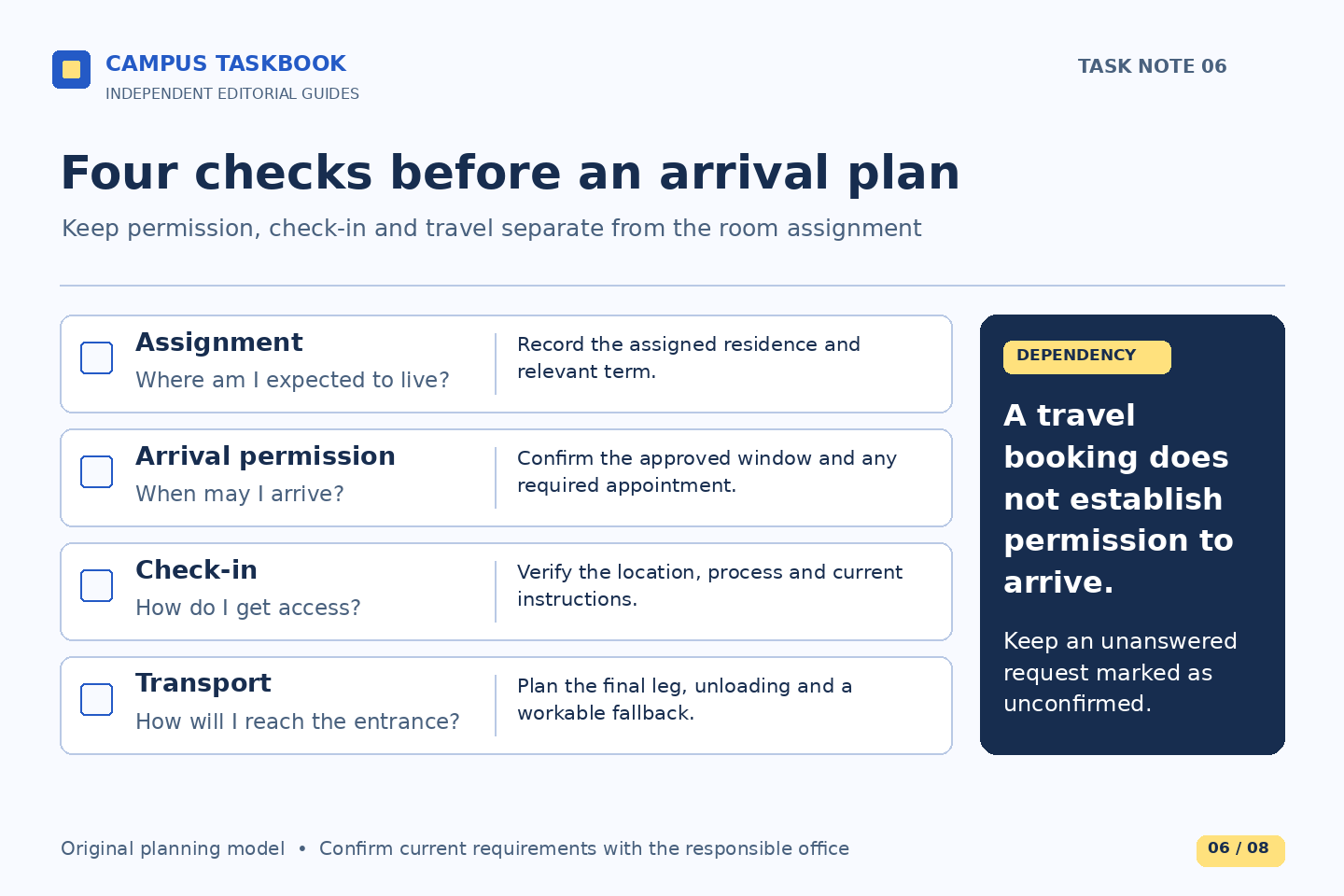
A housing assignment answers where you are expected to live. It does not, by itself, answer when a building opens, where you check in, whether an early arrival is approved, or how long unloading will take. A useful move-in plan keeps those questions separate until each has current evidence. Otherwise a correct room number can sit inside a very expensive travel mistake.
Boston College’s public Fall Opening page illustrates why the distinctions matter: it separates student groups and arrival arrangements, describes move-in appointments, and treats early arrival as a separate approval process. The page reviewed for this article concerned fall 2026. Its dates are historical context once that opening has passed; they are not a standing calendar for future semesters.
Build the plan from the least flexible item
Put four headings in a private planning note: assignment, approved arrival, check-in, and transport. Beside each, record the source and what remains uncertain. A room assignment belongs under assignment. A selected appointment belongs under arrival. An unanswered early-arrival request remains a request. A train ticket records a travel commitment, not university permission to enter a room.
Start with the requirement you cannot change yourself. If the official arrival window is not yet confirmed, mark transport as provisional rather than making the uncertainty disappear. Check the cancellation conditions of any travel or accommodation before committing money. This article does not establish that a particular room, arrival date, parking area or exception is available.
A fictional plan with one hidden dependency
Imagine a returning student knows the residence hall and wants to travel on a Thursday because a relative is available to drive. The general opening information describes Friday arrivals. The student has asked about Thursday access but has no approval. Writing “Thursday move-in” on the family calendar quietly converts a request into a fact.
A more accurate plan has two branches: Thursday only if the relevant office confirms the exception and its conditions; otherwise Friday within the assigned arrangements. The family can now decide how to handle the travel constraint without mistaking the student’s preference for a housing instruction. No real student, application or approval is described in this example.
Plan the last hundred metres
Travel planning often ends at a campus address, while the difficult part begins there. Recheck the current opening page for check-in location, appointment instructions and group-specific exceptions. Distinguish the building you will occupy from a central check-in point. A place shown on a campus map does not automatically permit vehicle unloading or overnight parking.
Coordinate bulky shared items before loading the car. Label which items are essential for the first night and which can wait. Keep personal housing correspondence private; roommates’ names and room details do not belong in a public question. If a direction is unclear, ask one concrete question about the arrival step rather than sending an entire set of private documents.
Close the loop after the decision
When an office replies, update the relevant planning line and note the date. Tell the people helping you which practical assumption changed: arrival day, check-in location, appointment or vehicle plan. Keep the official message available to you during travel, using a device you control.
Before a later semester, rebuild the dates from current information. The structure of the plan is reusable; the details are not. For housing decisions and individual arrangements, Residential Life is the source of authority. Campus Taskbook supplies a planning method and cannot confirm an assignment or grant access.
Read next: A campus route needs more than a map pin, or Read a meal plan as a set of different balances.