In this guide
Combine destination, service pattern, last-mile access and a fallback when planning a Boston College campus trip.
Location and arrival are different problems
A map answers where a place is. A timetable describes intended service. A live vehicle display estimates where a bus is now. None of these alone proves that you will be at the correct room before an appointment. A useful campus journey combines the three and adds walking, finding the entrance and any check-in time.
Boston College’s Transportation and Parking pages provide campus-specific parking maps and link to live shuttle tracking. Its shuttle page distinguishes regular service from summer, holiday and game-day arrangements. These distinctions are more durable than copying today’s departure interval into a general guide. Always open the current official schedule for the day you intend to travel.
Write the destination in layers
Use campus, building, entrance or meeting point, and room. “Boston College” is too broad when a university uses several campuses. A building name may still be inadequate if an event or appointment directs visitors to a particular entrance. Keep the address from the official invitation beside the location on the map until you are sure they refer to the same place.
If another person is joining you, agree on a visible meeting point and a way to handle separation. Avoid posting your regular travel routine or room details publicly. You can ask a general route question without disclosing a private appointment’s purpose.
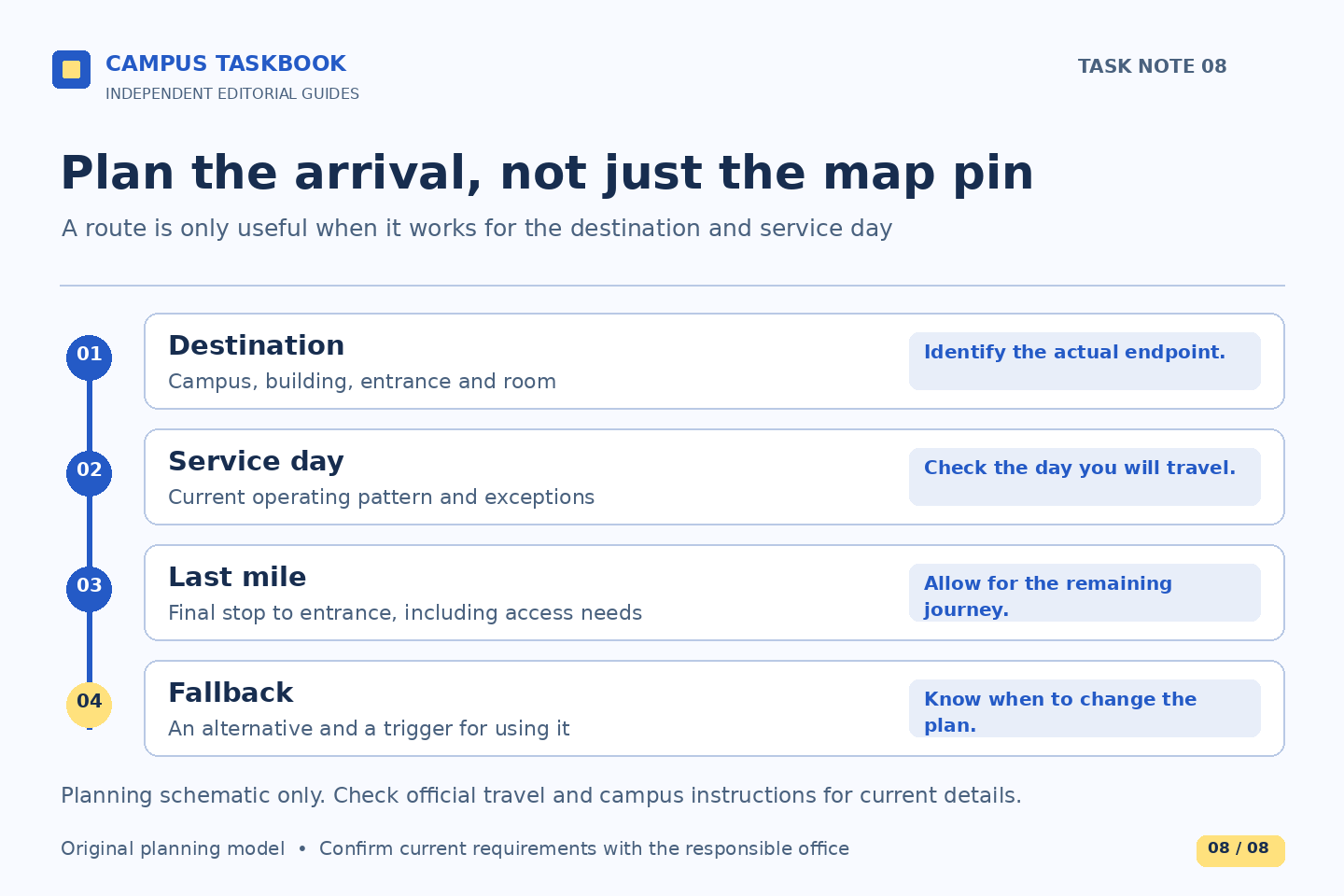
A fictional journey with a fragile transfer
Imagine a student has two commitments on different campuses with a short gap between them. A regular shuttle interval appears to fit. But the student has not allowed for leaving the first building, walking to the stop, finding the next room or waiting if the first vehicle is full or delayed. The apparent spare time exists only on paper.
Work backward from the second commitment. Reserve time for entry and room-finding, then walking, then the travel leg. Mark the remaining margin. If it is too small, investigate an earlier departure or ask whether the commitments can be adjusted. This is a planning example, not an estimate of an actual BC journey time.
Check the operating day, not just the weekday
A weekday during a break may not follow the ordinary term-time pattern. A campus event can change stops or vehicle access. The official shuttle page explicitly cautions that traffic, weather and other issues affect timing. A live tracker is useful evidence, but an icon moving on a map is not a guaranteed arrival time.
For driving, treat parking as its own task. A road entrance, drop-off space and authorized parking location have different functions. Read the current official parking instructions relevant to your visit or event instead of assuming that a campus map grants parking permission. Build your fallback before departure, especially for a time-sensitive appointment.
Make the plan easy to revise
A compact route note needs the date, intended arrival, destination details, chosen route, source and fallback. Recheck the source close to departure. If you are delayed, communicate the practical consequence promptly through the appropriate channel rather than trying to recover time through unsafe travel.
For an accessibility-related route need, consult BC’s current transportation accessibility information and the relevant office. Do not infer that a route is suitable from distance alone. Campus Taskbook has not ridden these routes, measured live travel times or verified the accessibility of a particular journey.
Read next: Housing is a sequence, not a single confirmation, or Turn an interesting event into an achievable plan.