In this guide
A calm method for comparing dated student-account information without confusing an aid award, a bill, and evidence of payment.
Three records, three different questions
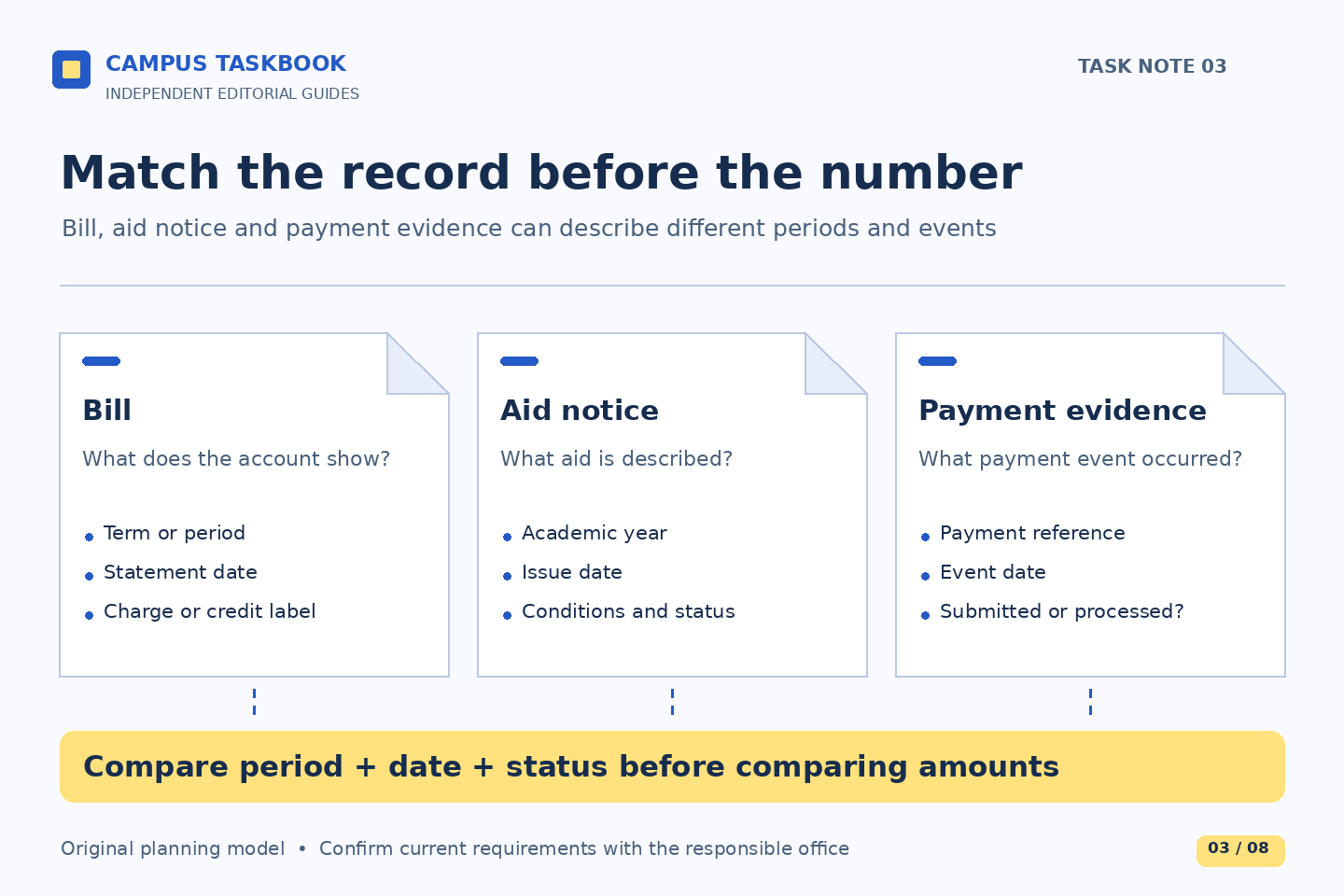
When several campus money screens show different figures, the first useful question is not “Which number is right?” Ask what each figure describes and when it was produced. An award record, an account statement, and a payment confirmation may all be relevant while referring to different events or periods. Comparing their largest visible numbers without that context can manufacture a discrepancy that the records themselves do not claim.
This guide is about reading and organizing records, not choosing financing, determining aid eligibility, or advising you how much to pay. Campus Taskbook cannot inspect your account or settle a billing question. Boston College’s current official information and the office responsible for the account must resolve individual cases. Keep full financial documents private; a useful question usually needs a specific observation rather than an entire personal financial history.
Build a dated comparison before doing arithmetic
Create a private comparison sheet with one row per document or screen. Record its name, the academic year or term, issue date if shown, date you viewed it, the particular field you are comparing, and any status label. Treat “not displayed” differently from zero. Treat “I have not found it” differently from “it does not exist.” Those distinctions keep incomplete information from silently becoming a financial assumption.
BC’s billing guidance distinguishes monthly statements from more recent account activity in My Bill. Its aid guidance separately lists application-document status, award status, and award information. These distinctions make a dated comparison especially valuable. A document-receipt status answers a different question from an award record; an older statement may not include activity visible later. The public descriptions do not establish whether any particular item has posted to your account.
Compare the same periods. If one record covers a year and another a semester, note the mismatch and ask how to compare them. Preserve the original labels instead of inventing a split.
A worked example of an apparent mismatch
Illustrative example, not a BC account: a student has a statement dated Monday, an award document dated Wednesday, and a payment confirmation dated Thursday. On Friday, the student sees an account figure that differs from Monday’s statement. The useful first step is a timeline. Monday’s document cannot, by its date alone, establish what happened on Thursday. Wednesday’s award document does not, by its date alone, establish when a related account entry should appear.
The student checks whether all three records concern the same period, then identifies the exact item that remains unexplained. A focused question could be: “I am comparing my dated statement with current account activity for the same term. I do not understand the status of one item. Which record should I use to verify whether it has been applied?” This asks for interpretation rather than asserting that the institution lost money or made an error.
If an office needs evidence, use its approved channel. Keep payment details, bank information, tax material, and unrelated family circumstances out of public screenshots or informal groups.
Keep the calendar as separate evidence
A timeline has more than one kind of date. A statement issue date tells you when a document was generated. A due date states a deadline. A payment-plan date concerns the arrangement described in its terms. A submission date records when you took a step. A processing or posting date concerns when that step becomes reflected elsewhere. Do not substitute one for another simply because they appear near the same amount.
BC’s billing page publishes different schedules and deadlines for different student groups, along with payment-plan information. Check the current section for the relevant group and period rather than copying a single campus-wide date into your calendar. This article deliberately does not reproduce a payment calendar: the live source, your actual statement, and any applicable arrangement need to be read together.
Work backward from the verified deadline to identify what needs clarification: a label, the correct period, or a required next step. Contact the responsible office while there is time to obtain an answer. An unanswered question does not move a deadline.
Ask for a reconciliation, not a guess
A useful account inquiry has a narrow subject, a period, two dated observations if comparison is needed, and one question. Avoid sending a long narrative that mixes admission, aid, registration, housing, and payment history unless the office asks for that context. It is easier to answer “What does this status mean for this item?” than to reconstruct the entire chain from attachments with unclear dates.
An effective private preparation note might say: “Term checked: spring. Record A: statement issued on the displayed date. Record B: current activity checked today. Difference to explain: the status of the specified credit. Requested answer: which additional information, if any, is needed to understand the record.” This is an editorial example, not a required BC form or a recommendation about payment.
Student Services publishes account and aid contact routes. Use the current route for your subject. Restoring technical access may help you collect evidence, but cannot itself explain a financial entry.
Finish with a documented answer
After receiving clarification, update the comparison sheet with the answer’s date, the office that provided it, and the exact remaining action, if any. Separate an explanation from a change to the account. If the office says a record will change, verify the relevant current record when appropriate rather than rewriting your earlier observation as if the change had already occurred.
Public sources checked on October 1, 2026 establish the kinds of records and published contact routes discussed here. They do not verify a balance, guarantee an award, confirm a payment, recommend a payment method, or determine eligibility. The goal of this method is narrower and practical: know which fact you have, which fact you still need, and where to ask for an authoritative answer.
Read next: Helping with a bill does not require sharing an account, or Read a meal plan as a set of different balances.