In this guide
Match a record to the recipient’s actual requirement, delivery route and deadline while sharing as little private information as needed.
A request for proof is not a document name
“Send proof you are a student” is incomplete. Does the recipient need enrollment for a particular term, a completed degree, a transcript, or something else? The cheapest-looking or fastest-looking document may still be the wrong evidence. Clarifying the requirement before ordering can avoid delay, unnecessary fees and excess disclosure.
Boston College’s enrollment-certification page distinguishes current-student requests from verification for external audiences and alumni. Its Registrar page also separates enrollment certification, transcript requests and other records functions. These are useful categories, but they do not tell you what a particular recipient will accept.
Write a five-part specification
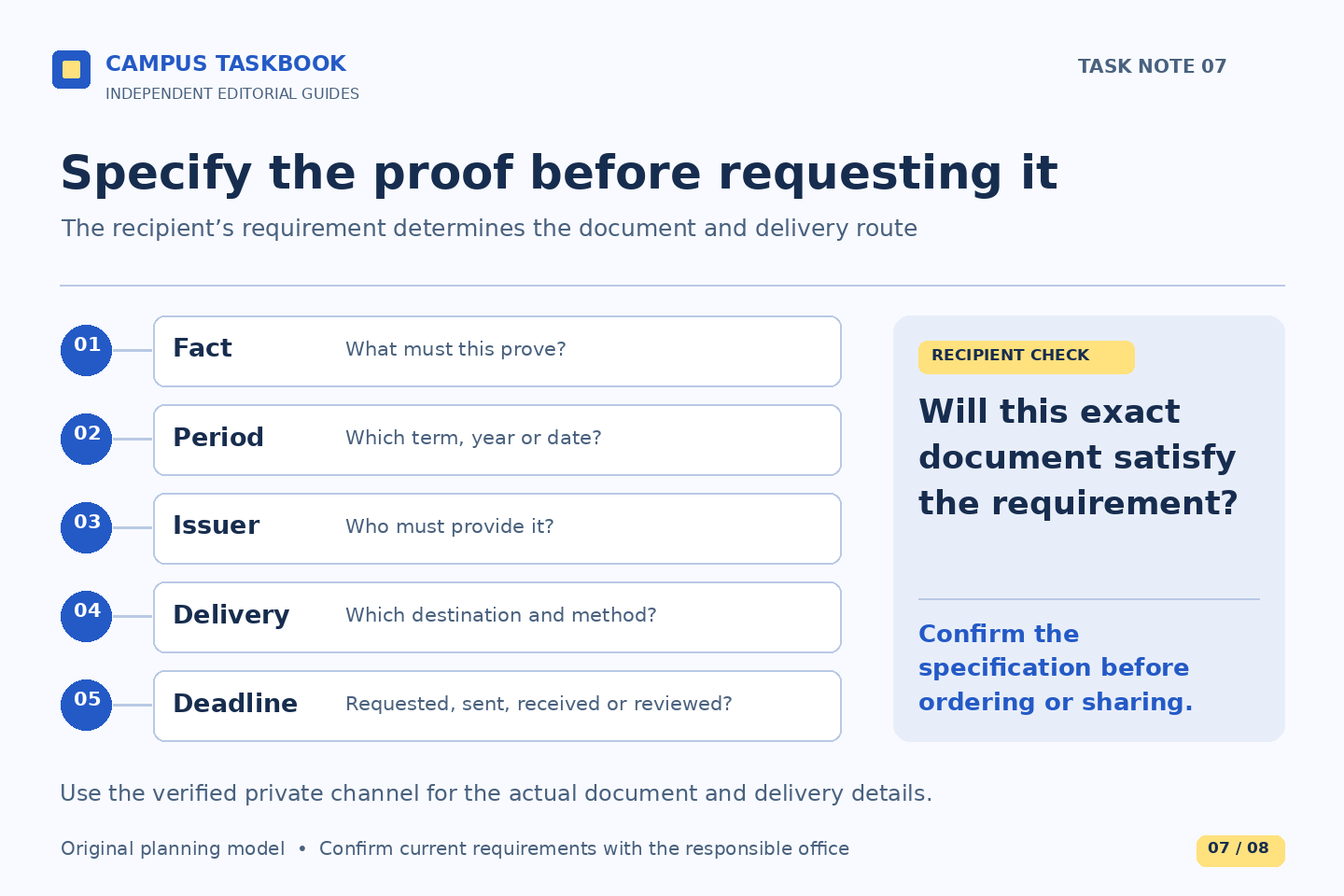
Identify the fact to prove, the relevant period, the required issuer, the permitted delivery method, and the deadline. Ask whether the deadline means requested, sent, received or reviewed. These are different milestones. If a recipient provides written requirements, keep those instructions available while choosing the official request route.
For example, “current enrollment for the fall term, issued through the university’s official process, delivered to the named recipient by a specified date” is much more actionable than “college paperwork.” Do not add a transcript, financial record or identity document simply because it is available. More information can make a handoff less appropriate, not more complete.
A fictional mismatch caught early
Imagine an external organization asks for confirmation of current enrollment. A student is about to send a full transcript because it appears more authoritative. Before ordering, the student asks whether a current enrollment certification would satisfy the requirement. The organization confirms that it would.
The clarification changes the task from sharing an extensive academic history to obtaining evidence of a narrower fact. This is an invented example and not a claim that every recipient accepts the same document. The actual organization must state its requirement, and the official issuer determines what it can provide.
Treat delivery as part of the evidence
Some recipients distinguish a document sent directly by an issuer from a copy forwarded by an applicant. Others specify an approved provider or particular format. Confirm that detail before entering a recipient address or paying a fee. A perfectly accurate document can be rejected if it arrives through the wrong route.
Check the recipient’s identity and contact details using a reliable source. Keep private records in the authorized delivery process. Do not upload them to a public reading tool or send them to this publication for checking. If a request seems broader than its purpose, ask the recipient to clarify why the additional fields are needed.
Keep a receipt, then verify the outcome
A request confirmation proves that a request was made; it may not prove that the recipient has received or accepted the record. Note the next expected milestone and the official way to check it. Preserve a reference number privately if one is issued, without reposting it publicly.
If the deadline is close, ask the recipient which alternatives or timing arrangements it accepts rather than inventing an exception. For BC’s current enrollment-certification routes, start at the linked official page. Campus Taskbook cannot issue records, verify enrollment, certify degree completion or promise processing times. The value of this method is a precise handoff, not an eligibility decision.
Read next: Ask the right questions before ordering a transcript, or Helping with a bill does not require sharing an account.